
FBA Kitting in China: Bundles, Sets and Multipacks
FBA Kitting in China helps Amazon sellers combine products, accessories, inserts and packaging into ready-to-sell bundles before inventory is shipped to Amazon fulfillment centers. For sellers who source products from China, kitting close to the supplier can reduce handling steps, improve quality control and make Amazon FBA prep more reliable.
Bundles, sets and multipacks can be profitable because they create differentiated offers, improve average order value and make it harder for competitors to copy a listing exactly. But kitting also adds operational risk. If one component is missing, the wrong label is applied or the packaging does not match the listing, Amazon customers may receive incomplete products and the seller may face refunds, negative reviews or listing problems.
This guide explains how FBA kitting in China works, when sellers should use it, how it connects with inspection, labeling, consolidation and shipping, and how Fyllhub can support FBA kitting for Amazon sellers that need a cleaner bundle preparation workflow.
What Is FBA Kitting?
FBA kitting is the process of combining multiple items into one sellable unit before sending inventory to Amazon FBA. The final kit may include several products, accessories, instruction cards, inserts, packaging materials or promotional items. Once assembled, the kit is labeled and packed as one unit for Amazon receiving and customer fulfillment.
Examples of FBA kits include:
- Two-pack or three-pack multipacks
- Product plus accessory bundles
- Gift sets
- Starter kits
- Refill kits
- Replacement part sets
- Seasonal bundles
- Trial packs
- Beauty or wellness sets
- Kitchen or home product sets
- Electronics accessory kits
The important point is that Amazon sees the kit as one sellable SKU. The warehouse must assemble the correct components, pack them consistently and apply the correct label before shipment.
Why Amazon Sellers Use Kitting in China
Many Amazon sellers source products, packaging and accessories from China. If the components are already in China, it can be more efficient to assemble the kit before shipping to Amazon rather than sending separate parts to another country for assembly.
Components are near the suppliers
A kit may include products from several factories. One supplier may produce the main product, another may produce a case, another may print inserts and another may make packaging. A China kitting partner can receive all components and assemble the final unit near the source.
Amazon prep can be centralized
Kitting often requires labels, packaging, barcode checks and carton preparation. A China warehouse can handle kitting and Amazon FBA prep service in one workflow instead of asking each supplier to understand Amazon requirements.
Freight may be more efficient
Shipping components separately can create waste. Assembling kits in China can reduce repeated handling and allow sellers to ship finished FBA-ready units to Amazon.
Quality issues can be caught earlier
If a component is missing or defective, it is better to discover the problem before the kit reaches Amazon. Kitting in China creates a checkpoint where components can be counted and checked before final packing.
Bundles can protect product positioning
Amazon sellers use bundles to create a unique offer, improve conversion and differentiate from commodity listings. A well-built bundle can make the product feel more complete and valuable.
FBA Kitting vs Bundling vs Multipacks
These terms are related, but they are not always the same.
FBA kitting is the operational process of assembling a sellable unit. It can include bundling, multipacking, labeling and repacking.
A bundle usually combines different products into one offer. For example, a kitchen tool plus replacement parts and a recipe card may become one bundle.
A multipack usually combines several units of the same product. For example, a three-pack of filters or a two-pack of organizers may be treated as one sellable unit.
A set may combine related products that belong together. For example, a travel kit might include a pouch, bottle, tool and instruction card.
From a warehouse perspective, the process is similar: identify components, assemble the correct combination, pack consistently and apply the right label.
When FBA Kitting Makes Sense
FBA kitting is useful when the bundle strategy improves the product offer or simplifies the supply chain.
You sell product bundles
If your Amazon listing includes more than one component, those items must be assembled before shipping to Amazon. Kitting ensures the final package matches the listing.
You use multiple suppliers
When components come from different factories, a kitting partner can receive and combine them. This is closely related to Amazon FBA consolidation because supplier goods often need to be gathered before assembly.
You want stronger differentiation
Bundles can make a product harder to compare directly against competitors. A useful accessory, printed guide or branded package can improve perceived value.
You need custom packaging
Some kits require branded boxes, bags, inserts, stickers or product manuals. Assembling the kit in China can be practical when packaging is also produced there.
You need better prep control
If suppliers are not reliable with labels, carton rules or Amazon prep, a kitting workflow gives the seller one controlled place to prepare inventory.
When Kitting May Not Be Worth It
Kitting adds labor and process complexity. It should support a clear business goal.
Kitting may not be necessary when:
- A single product sells well without a bundle.
- The bundle does not increase conversion or margin.
- Components are expensive to assemble.
- The kit creates more returns or confusion.
- Supplier packaging is already Amazon-ready.
- Urgent shipping is more important than custom assembly.
Before scaling a kit, sellers should test demand and review the total cost. A bundle that looks attractive may not be profitable if assembly labor, packaging, freight and returns are too high.
The FBA Kitting Process in China
A reliable kitting workflow should be documented before components arrive at the warehouse.
Step 1: Define the final kit
The seller confirms exactly what belongs in each kit. This includes component SKUs, quantities, packaging, inserts, labels and final carton rules. A photo reference is helpful because it reduces interpretation errors.
Step 2: Receive components
The kitting partner receives goods from suppliers. The warehouse records supplier name, SKU, quantity, carton count and visible damage. If components come from several suppliers, the warehouse should confirm when all required items have arrived.
Step 3: Check quantities and condition
Before assembly begins, the warehouse checks whether components match the expected quantities. Basic visual checks can catch obvious defects, packaging damage or missing accessories.
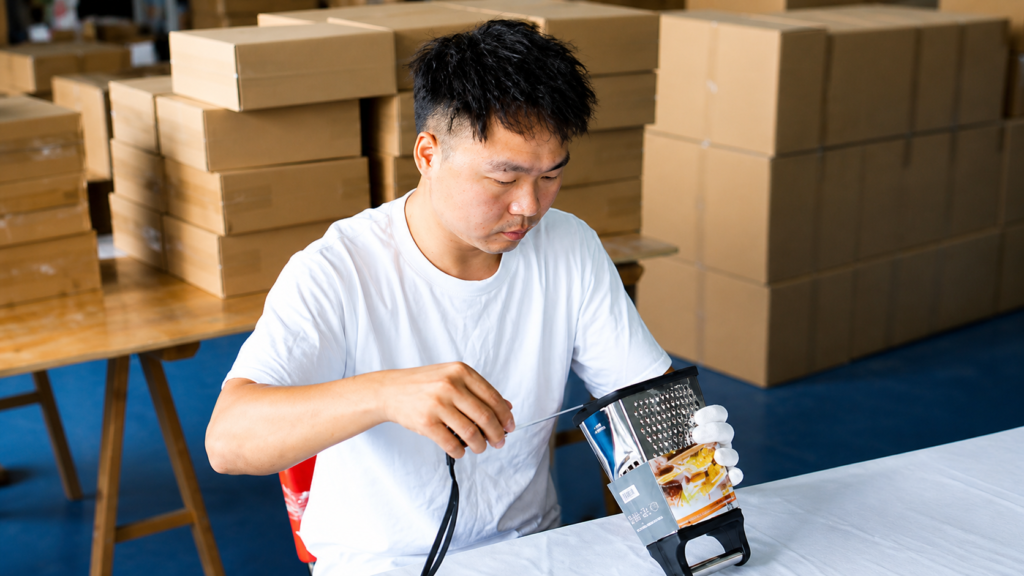
Step 4: Assemble the kit
Warehouse staff combine the correct components according to the kitting instructions. This may include placing items in a box, adding inserts, sealing bags, applying stickers or arranging products in a branded package.
Step 5: Apply labels
The final kit usually needs an FNSKU label, bundle label, suffocation warning or other Amazon-required label. Labels must match the final sellable unit, not the individual components.
Step 6: Pack for FBA shipment
Completed kits are packed into cartons according to Amazon and freight requirements. Carton labels, counts, weights and dimensions should be confirmed before outbound shipping.
Step 7: Ship to Amazon
The prepared kits are handed to a freight partner for Amazon FBA shipping from China. The route may use express, air freight, sea freight or DDP shipping depending on the shipment.
Kitting Instructions Sellers Should Prepare
Clear instructions are the heart of successful FBA kitting. If instructions are vague, the warehouse may assemble kits inconsistently.
Sellers should provide:
- Final kit SKU
- Component SKU list
- Quantity of each component
- Photos of each component
- Final kit photo reference
- Packaging material list
- Insert or manual requirements
- Label files
- Label placement instructions
- Bundle or multipack wording
- Carton packing rules
- Inspection checklist
- Approved defect limits
- Target completion date
The more specific the instructions, the easier it is for the warehouse to repeat the process accurately.
FBA Kitting and Amazon Labeling
Labeling is one of the most important parts of FBA kitting. The final kit must be labeled as the sellable unit Amazon expects. If labels are placed on individual components incorrectly, Amazon may receive the inventory as separate products or fail to scan the correct SKU.
Common labels may include:
- FNSKU labels
- Bundle labels
- Multipack labels
- Suffocation warning labels
- Expiration date labels
- Carton labels
- Fragile labels
- Country of origin labels where relevant
Sellers should review Amazon FBA labeling requirements before the kitting project starts. Labels should be printed clearly, placed consistently and protected from damage during shipping.
Inspection Before and During Kitting
Kitting is a good time to catch problems because every component passes through the warehouse workflow. Sellers can request checks before assembly, during assembly or after kits are complete.
Inspection may include:
- Component quantity checks
- Visual appearance checks
- Packaging checks
- Color or size confirmation
- Accessory confirmation
- Barcode checks
- Function checks for simple products
- Final kit completeness checks
- Photo confirmation
- Carton count checks
For higher-risk products, sellers may use a dedicated Amazon FBA inspection process before kitting begins. This helps prevent defective components from being assembled into finished kits.
Packaging Decisions for FBA Kits
Packaging affects customer perception, freight cost and Amazon receiving. A kit should be packed securely enough to protect components but efficiently enough to avoid unnecessary dimensional weight.
Packaging options may include:
- Poly bags
- Branded boxes
- Mailer boxes
- Insert cards
- Stickers
- Product sleeves
- Bubble wrap
- Inner cartons
- Retail packaging
- Protective dividers
Sellers should test packaging before scaling. A box that looks attractive may be too large for freight. A bag that saves space may not protect the product. The right packaging balances brand value, protection and cost.
FBA Kitting for Multipacks
Multipacks look simple, but they still need careful prep. A two-pack or three-pack should be clearly marked as one sellable unit. Customers should not receive separated units unless the listing promises separate items.
For multipacks, sellers should decide:
- How many units are included
- Whether units are bagged, boxed or banded
- Whether a multipack label is required
- Where the FNSKU should be placed
- Whether individual barcodes need to be covered
- How units should be arranged in cartons
Incorrect multipack prep can cause Amazon receiving confusion and customer complaints.
FBA Kitting for Bundles and Sets
Bundles and sets usually require more instructions than multipacks because they include different components. The warehouse must confirm that each component is present and correct.
For bundles, sellers should provide a bill of materials. This is a simple component list that tells the warehouse exactly what goes into one finished kit. The bill of materials should match the Amazon listing.
If the bundle includes printed material, sellers should confirm the latest version of the insert or manual. Old inserts, outdated claims or wrong instructions can create compliance or customer service problems.
Costs to Understand
FBA kitting costs depend on labor, complexity and materials. Sellers should compare total cost, not only the assembly fee.
Cost factors include:
- Receiving components
- Storage before assembly
- Component checks
- Assembly labor
- Packaging materials
- Label printing
- Label application
- Repacking
- Carton preparation
- Photo confirmation
- Inspection
- Freight after kitting
The cheapest kitting option may not be the best if mistakes lead to returns, negative reviews or Amazon receiving issues. Sellers should focus on accuracy and repeatability.
Common FBA Kitting Mistakes
Vague component instructions
If the warehouse does not know exactly what belongs in each kit, mistakes are likely. Every kit needs a clear component list.
Wrong FNSKU placement
The final kit label must match the sellable unit. Labels on individual components can create confusion.
Missing accessory checks
Small accessories are easy to miss. Use checklists and sample photos to confirm kit completeness.
Oversized packaging
Large packaging can increase freight and storage costs. Test packaging size before scaling.
No inspection before assembly
Defective components should be caught before they are added to kits. Otherwise, completed kits may need to be reopened.
Scaling before testing
Sellers should test a small batch before producing thousands of kits. This confirms instructions, packaging and label placement.
How to Choose an FBA Kitting Partner in China
The right partner should understand Amazon FBA rules, warehouse operations and supplier coordination. Kitting requires more detail than simple storage.
Ask these questions:
- Can you receive goods from multiple suppliers?
- Can you check component quantities?
- Can you assemble bundles and multipacks?
- Can you store packaging materials?
- Can you apply FNSKU and bundle labels?
- Can you cover manufacturer barcodes when needed?
- Can you provide photos during assembly?
- Can you inspect finished kits?
- Can you prepare cartons for Amazon FBA?
- Can you coordinate freight to Amazon?
- Can you support repeat kitting projects?
A good partner should help the seller document the process and repeat it accurately. Communication and consistency matter more than a low assembly rate.
How Fyllhub Helps With FBA Kitting in China
Fyllhub helps Amazon sellers assemble bundles, sets and multipacks in China before shipment to Amazon. This is useful for sellers that source components from Chinese suppliers and need a controlled workflow for receiving, checking, assembling, labeling and shipping.
Fyllhub can help with:
- Supplier receiving
- Component consolidation
- China warehouse storage
- Basic component checks
- Bundle assembly
- Multipack preparation
- Branded packaging support
- Insert and accessory handling
- FNSKU labeling
- Bundle and multipack labels
- Carton preparation
- Amazon FBA prep
- Freight forwarding coordination
This workflow helps sellers create a finished FBA-ready product before inventory leaves China. Instead of asking each supplier to assemble or label products separately, sellers can centralize the kitting process.
If you need FBA kitting in China for bundles, sets or multipacks, you can request a custom quote from Fyllhub. Share your component list, supplier locations, kit instructions, packaging requirements, label files, expected quantity and target shipment date.
FAQ
What is FBA kitting?
FBA kitting is the process of combining multiple products, accessories or packaging components into one sellable Amazon FBA unit, then labeling and packing it for shipment to Amazon.
Why use FBA kitting in China?
FBA kitting in China is useful when products, accessories or packaging are sourced from Chinese suppliers. It allows sellers to assemble, inspect, label and prepare kits before international shipping.
What is the difference between a bundle and a multipack?
A bundle usually combines different products into one offer, while a multipack combines several units of the same product. Both can require kitting before Amazon FBA shipment.
Can Fyllhub assemble Amazon bundles from multiple suppliers?
Fyllhub can help receive components from multiple China suppliers, consolidate them, assemble bundles, apply labels, prepare cartons and coordinate outbound shipping to Amazon.
Do FBA kits need special labels?
Many FBA kits need FNSKU labels, bundle labels, multipack labels or warning labels. The exact label requirements depend on the product, packaging and Amazon listing setup.
Should products be inspected before kitting?
Yes, inspection can help catch defective or missing components before they are assembled into finished kits. This reduces rework and customer complaint risk.
How do I start an FBA kitting project?
Prepare the kit SKU, component list, photos, packaging instructions, label files, expected quantity, supplier contacts and target shipping date. Then request a quote from a China kitting partner.
Final Thoughts
FBA Kitting in China can help Amazon sellers create stronger bundle offers while keeping preparation close to the source of production. It is especially useful when components, packaging and inserts come from Chinese suppliers.
The best kitting workflow starts with clear instructions. Sellers should define the final kit, prepare labels, confirm packaging, inspect components and test a small batch before scaling. Accuracy matters because every completed kit should match the Amazon listing exactly.
Fyllhub can help sellers assemble and prepare FBA kits in China. To plan your next bundle, set or multipack project, request a quote from Fyllhub.





 Chat on WhatsApp