
Alibaba to Amazon FBA: Sourcing, Prep and Shipping Workflow
Alibaba to Amazon FBA is a common sourcing and logistics workflow for sellers who find products on Alibaba, buy from Chinese suppliers and send inventory to Amazon fulfillment centers. It can be a powerful model, but only when sourcing, inspection, prep, labeling, consolidation and shipping are managed carefully. Buying from Alibaba is the beginning of the process, not the whole process.
Many sellers make the mistake of treating Alibaba suppliers as a complete FBA solution. Some suppliers can help with production and basic packing, but they may not fully understand Amazon labeling rules, carton requirements, product inspection, shipment consolidation or freight delivery to Amazon warehouses. If sellers skip those steps, inventory can arrive with defects, wrong labels, missing components or expensive shipping problems.
This guide explains the full Alibaba to Amazon FBA workflow, including how to evaluate suppliers, inspect products, prepare FBA labels, consolidate shipments, choose freight routes and how Fyllhub can support Alibaba FBA service from China sourcing to Amazon delivery.
What Is Alibaba to Amazon FBA?
Alibaba to Amazon FBA is the process of sourcing products from suppliers found on Alibaba and sending those products to Amazon fulfillment centers for sale through Fulfillment by Amazon. Amazon handles customer order storage, picking, packing and delivery after inventory is received, but the seller is responsible for getting products to Amazon correctly.
The workflow usually includes:
- Product research
- Supplier search on Alibaba
- Supplier communication
- Sample order
- Price and MOQ negotiation
- Production order
- Product inspection
- FBA prep
- FNSKU labeling
- Carton labeling
- Supplier consolidation if needed
- Freight forwarding
- Delivery to Amazon warehouses
- Amazon receiving and inventory monitoring
Every step matters. A good product can still become a bad launch if the supplier sends defective units, labels are wrong or shipping is delayed.
Why Sellers Use Alibaba for Amazon FBA
Alibaba is popular because it gives sellers access to thousands of manufacturers, trading companies and product categories in China. Sellers can compare suppliers, request samples, customize packaging and negotiate production orders.
For Amazon sellers, Alibaba can support:
- Private label product sourcing
- Product customization
- Custom packaging
- Accessories and bundle components
- Low or medium MOQ testing
- Supplier comparison
- Factory direct communication
- International sourcing from China
However, Alibaba is a marketplace, not a full logistics system. The seller still needs to verify supplier quality, production accuracy and Amazon readiness.
Step 1: Choose the Right Product for FBA
Before contacting suppliers, sellers should decide whether the product is suitable for Amazon FBA. Product selection affects sourcing, inspection, packaging, shipping cost and Amazon compliance.
Important product questions include:
- Is the product lightweight enough for profitable shipping?
- Is it fragile, liquid, magnetic, battery-powered or restricted?
- Does it need certification or compliance documents?
- Is the product easy to inspect?
- Can packaging survive international freight?
- Does the product have enough margin after FBA fees and shipping?
- Can it be differentiated with branding, packaging or bundles?
- Is demand stable or seasonal?
The best Alibaba product for Amazon is not only cheap to buy. It must be practical to manufacture, inspect, ship and sell profitably.
Step 2: Find and Compare Alibaba Suppliers
Supplier choice is one of the biggest risks in the Alibaba to Amazon FBA workflow. Sellers should compare more than price. A very low quote can hide weak materials, poor quality control, bad communication or missing packaging details.
When comparing suppliers, review:
- Business type: manufacturer or trading company
- Years on Alibaba
- Product specialization
- Response quality
- MOQ flexibility
- Sample availability
- Custom packaging ability
- Export experience
- Certifications if needed
- Production timeline
- Quality control process
- Willingness to follow FBA prep requirements
Sellers should ask detailed questions. A serious supplier should be able to explain material options, packaging, carton dimensions, lead time and customization. If a supplier gives vague answers before payment, communication may become worse after production starts.
Step 3: Order Samples and Check Quality
Samples help sellers evaluate product quality before placing a larger order. A sample should be reviewed for appearance, function, size, material, packaging, instructions and customer experience.
When checking samples, sellers should consider:
- Does the product match the listing idea?
- Are materials acceptable?
- Is the product durable enough?
- Are dimensions correct?
- Does it need better packaging?
- Are there sharp edges, odor, defects or loose parts?
- Does it need instructions?
- Would customers understand how to use it?
- Does it match Amazon category expectations?
Sample quality does not guarantee mass production quality. Sellers should still inspect production units before shipping to Amazon.
Step 4: Confirm Product Specifications Before Production
Before placing the production order, sellers should create clear product specifications. This reduces confusion and gives the supplier a standard to follow.
Specifications may include:
- Product name
- Material
- Dimensions
- Color
- Weight
- Function details
- Packaging type
- Logo placement
- Insert or manual details
- Barcode or label requirements
- Carton quantity
- Carton dimensions
- Defect standards
- Inspection checklist
If the seller uses custom packaging or inserts, final artwork should be approved before production. Small mistakes in packaging can create delays or force repacking later.
Step 5: Plan Amazon FBA Prep Early
Amazon FBA prep should be planned before production finishes. Waiting until goods are ready can create rushed labeling and shipment mistakes.
FBA prep may include:
- FNSKU labels
- Carton labels
- Poly bagging
- Suffocation warnings
- Bubble wrap
- Bundle labels
- Multipack labels
- Expiration date labels
- Product inserts
- Repacking
- Carton reinforcement
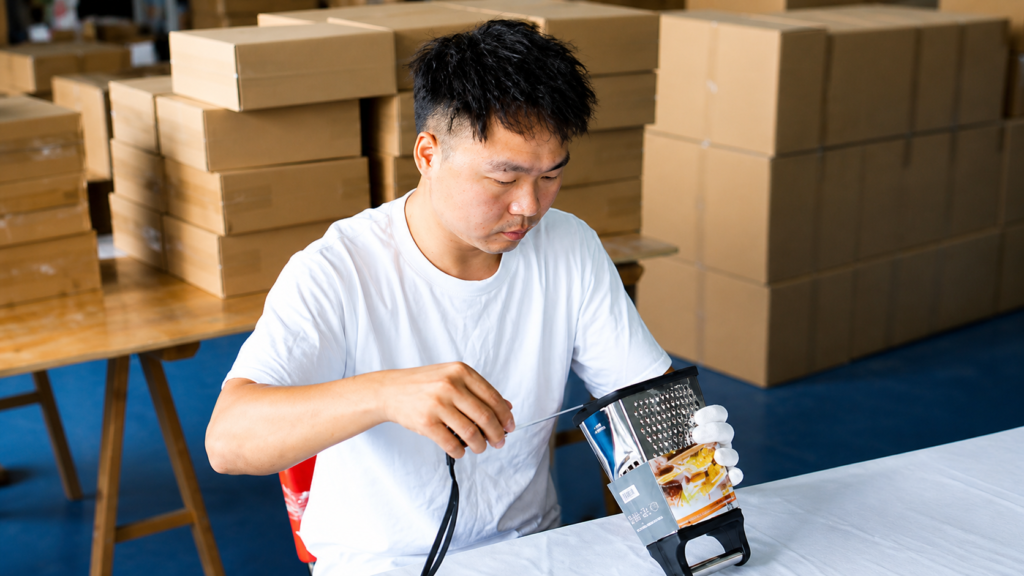
Fyllhub's Amazon FBA prep service in China can help sellers prepare inventory before it leaves China. This is useful when Alibaba suppliers do not fully understand Amazon requirements or when several suppliers are involved.
Step 6: Inspect Goods Before Shipping
Inspection is one of the most important steps in the Alibaba to Amazon FBA workflow. Once defective goods reach Amazon, fixing the problem becomes much harder.
An Amazon FBA inspection can check:
- Product appearance
- Quantity
- Packaging
- Function
- Accessories
- Color and size
- Barcode accuracy
- Carton condition
- Label placement
- Bundle completeness
Sellers should not rely only on supplier photos. A supplier may show good units while defective units remain in cartons. Inspection gives the seller a chance to identify problems before final payment or shipment.
Step 7: Decide Whether to Use Supplier Shipping or a Prep Partner
Some Alibaba suppliers offer to ship directly to Amazon. This may work for simple shipments, but it can create risk if the supplier does not understand Amazon requirements.
Direct supplier shipping may be suitable when:
- There is one simple SKU.
- The supplier has proven FBA experience.
- No inspection or repacking is needed.
- Labels and carton details are correct.
- The shipment is small and urgent.
A prep partner may be better when:
- Multiple suppliers are involved.
- Products need inspection.
- FNSKU labels must be applied.
- Cartons need relabeling or repacking.
- Bundles or kits must be assembled.
- Freight routes need comparison.
- The seller wants more control before shipping.
A China prep partner acts as a checkpoint between Alibaba supplier and Amazon warehouse.
Step 8: Consolidate Suppliers When Needed
Many sellers source more than one product or component from Alibaba. A bundle may include products from several suppliers, or a launch may include several SKUs. In those cases, Amazon FBA consolidation can help.
Consolidation means receiving goods from multiple suppliers into one warehouse, checking cartons, sorting SKUs, applying labels and preparing one cleaner outbound shipment.
Consolidation can help sellers:
- Reduce small-shipment freight waste
- Combine bundle components
- Check supplier quantities
- Apply labels consistently
- Prepare cartons for Amazon
- Improve freight planning
- Reduce supplier coordination work
If one supplier is late, the seller can decide whether to wait, split the shipment or ship available inventory first.
Step 9: Choose the Right Shipping Method
Shipping from Alibaba suppliers to Amazon can use several routes. The best option depends on shipment size, urgency, product type and destination marketplace.
Express courier
Express can be useful for samples, small urgent shipments or initial launch inventory. It is fast but often expensive per kilogram.
Air freight
Air freight can be a good choice for medium-sized shipments or urgent replenishment. It is faster than sea freight and may be more economical than express for larger volumes.
Sea freight
Sea freight is usually best for larger shipments with enough planning time. It can reduce cost per unit but requires longer lead time and careful inventory planning.
DDP shipping
DDP shipping means duties and import-related charges are handled before delivery. For Amazon sellers, this can simplify delivery because Amazon should not be responsible for import charges. Route availability depends on product type, destination and declared value.
Sellers can review Amazon FBA shipping from China before choosing a route.
Step 10: Prepare Documents and Carton Data
Freight partners need accurate shipment information. Sellers should collect documents and data before booking shipping.
Common details include:
- Supplier name and address
- Product description
- HS code if available
- Unit value and total value
- Quantity
- Carton count
- Carton dimensions
- Gross weight
- Packing list
- Commercial invoice
- Amazon shipment ID
- Destination marketplace
- FNSKU and SKU details
- Battery, liquid, magnet or restricted goods information
Incorrect documents can cause customs delays. Wrong carton data can affect freight quotes and Amazon shipment plans.
Payment Timing and Risk Control
Alibaba orders often involve deposit and balance payments. Many suppliers request a deposit before production and the remaining balance before shipment. Sellers should connect payment timing with inspection and logistics milestones instead of paying the full balance without checking production.
A practical workflow is to confirm the sample, approve product specifications, pay the deposit, monitor production, inspect finished goods and then release the balance after serious issues are resolved. This does not eliminate every risk, but it gives the seller more leverage before inventory leaves the supplier.
Sellers should also keep written records of specifications, packaging requirements, label instructions, carton details and agreed defect standards. If a dispute appears, clear documentation is easier to use than chat history alone. For larger orders, sellers may also use Alibaba Trade Assurance, staged payments or third-party inspection reports to reduce risk.
Logistics should be part of the payment discussion. If goods need to move to a prep warehouse, consolidation center or inspection location before final shipment, the supplier should know the delivery address and timeline. A supplier that expects to ship directly to Amazon may be confused if the seller later asks for cartons to be delivered to a China warehouse.
First Order Testing Before Scaling
New sellers should treat the first Alibaba to Amazon FBA order as a controlled test, not only as a purchase order. A smaller first shipment can verify supplier quality, packaging, label accuracy, freight timing, Amazon receiving and early customer feedback before the seller commits to a larger reorder.
After the first shipment is live, review customer reviews, return reasons, FBA receiving discrepancies, shipping cost per unit and actual sales velocity. If the product performs well, the second order can be larger and more structured. If problems appear, the seller can adjust specifications, packaging, inspection criteria or supplier choice before scaling.
Step 11: Monitor Amazon Receiving
The workflow does not end when goods are delivered to Amazon. Sellers should monitor Amazon receiving to confirm inventory becomes available for sale.
Check:
- Delivered units
- Received units
- Missing units
- Stranded inventory
- Listing status
- FBA shipment discrepancies
- Customer feedback after launch
If receiving discrepancies appear, the seller may need carton records, shipping documents, photos or warehouse reports to investigate.
Common Alibaba to Amazon FBA Mistakes
Choosing suppliers only by price
Low price can lead to poor materials, weak packaging, bad communication or inconsistent production. Compare total risk, not just unit cost.
Skipping samples
Samples help sellers understand product quality before committing to a larger order. Skipping samples increases launch risk.
Not documenting specifications
If product details are not written clearly, the supplier may make assumptions. A specification sheet helps prevent disputes.
Trusting supplier photos as inspection
Supplier photos are useful, but they are not the same as independent inspection. Sellers should verify production quality before shipping.
Waiting too long to plan FBA labels
FBA labels should be ready before prep begins. Last-minute labeling can cause errors.
Sending products directly to Amazon without checks
If goods arrive at Amazon with defects or wrong labels, fixing the issue can be slow and expensive.
Ignoring freight timing
Production, prep, shipping and Amazon receiving all take time. Sellers should plan replenishment before inventory runs out.
How Fyllhub Helps With Alibaba to Amazon FBA
Fyllhub helps Amazon sellers manage the workflow between Alibaba suppliers and Amazon FBA. Instead of relying on suppliers alone, sellers can use Fyllhub as a China-based logistics checkpoint for sourcing support, inspection, prep, consolidation and shipping coordination.
Fyllhub can help with:
- Supplier communication support
- China sourcing support
- Sample coordination
- Supplier receiving
- Product inspection
- Amazon FBA prep
- FNSKU labeling
- Carton labeling
- Repacking and relabeling
- Supplier consolidation
- FBA kitting and bundles
- China warehouse storage
- Freight forwarding coordination
- Amazon FBA shipping from China
This workflow helps sellers reduce risk between Alibaba purchase and Amazon receiving. It also gives the seller more visibility before inventory leaves China.
If you are sourcing from Alibaba and need help preparing products for Amazon FBA, you can request a custom quote from Fyllhub. Share your Alibaba supplier details, product type, SKU count, inspection needs, label requirements, target Amazon marketplace and shipping timeline.
FAQ
What is Alibaba to Amazon FBA?
Alibaba to Amazon FBA is a workflow where sellers source products from Alibaba suppliers, prepare inventory for Amazon FBA and ship products from China to Amazon fulfillment centers.
Can Alibaba suppliers ship directly to Amazon FBA?
Some suppliers can ship directly to Amazon, but sellers should confirm labels, carton details, inspection, documents and Amazon requirements before relying on supplier shipping.
Do I need inspection before shipping Alibaba products to Amazon?
Inspection is strongly recommended because it helps catch defects, packaging problems, missing accessories and label issues before goods reach Amazon.
What is an Alibaba FBA service?
An Alibaba FBA service helps sellers manage the process between Alibaba suppliers and Amazon FBA, including receiving, inspection, prep, labeling, consolidation and shipping.
Can Fyllhub help with Alibaba to Amazon FBA?
Fyllhub can help with sourcing support, supplier receiving, inspection, Amazon FBA prep, labeling, consolidation, kitting, warehouse storage and FBA shipping from China.
What shipping method is best from Alibaba to Amazon FBA?
The best shipping method depends on shipment size, product type, urgency and budget. Express is fast for small shipments, air freight is useful for faster replenishment and sea freight is common for larger shipments.
How do I start an Alibaba to Amazon FBA project?
Prepare supplier details, product specifications, sample results, SKU list, label files, inspection requirements, carton details and target Amazon marketplace. Then request a quote from a China FBA service partner.
Final Thoughts
Alibaba to Amazon FBA can be a profitable workflow, but it needs more than finding a supplier and booking freight. Sellers need to verify products, prepare labels, inspect goods, manage carton data, choose the right shipping route and monitor Amazon receiving.
The safest workflow creates a checkpoint in China before inventory leaves the supplier network. This checkpoint can include inspection, FBA prep, consolidation, kitting, warehouse storage and shipping coordination.
Fyllhub can help sellers manage that process from Alibaba supplier to Amazon fulfillment center. To plan your next Alibaba to Amazon FBA shipment, request a quote from Fyllhub.





 Chat on WhatsApp