
Ecommerce Logistics from China: Sourcing, QC, Storage and Shipping
Ecommerce Logistics China is the operating system behind many modern ecommerce brands. Products are sourced from Chinese suppliers, inspected before export, stored in a warehouse, prepared for sales channels, shipped to customers or marketplaces and replenished as demand changes. When the workflow is organized, sellers can scale with confidence. When the workflow is messy, the brand pays through delays, defects, stockouts, high freight cost and unhappy customers.
Many sellers think of logistics only after they find a product. That is backwards. The sourcing decision affects packaging, inspection, carton size, shipping method, customs data, fulfillment cost, delivery time and return risk. A product with strong demand can still fail if the logistics model does not fit the margin and customer promise.
This guide explains how to plan ecommerce logistics from China across sourcing, quality control, warehousing, freight, order fulfillment and inventory management. It also shows how Fyllhub can support China sourcing and fulfillment workflows for ecommerce brands.
What Ecommerce Logistics from China Includes
Ecommerce logistics from China is more than shipping. It covers the full movement of product information, physical goods and operational decisions from supplier to customer.
A complete workflow may include:
- Supplier research and vetting
- Product sampling
- Quotation comparison
- Purchase order management
- Production tracking
- Quality control inspection
- Carton and packaging checks
- Supplier consolidation
- China warehouse receiving
- SKU storage
- Labeling and barcoding
- Kitting and bundling
- Order fulfillment
- DDP shipping
- Freight forwarding
- Amazon FBA prep
- Marketplace replenishment
- Return and replacement handling
The goal is to create one coordinated system. Each step should make the next step easier. If sourcing, inspection, storage and shipping are handled separately with poor communication, errors multiply.
Start with Sourcing Strategy
Good logistics starts with sourcing. A seller should not choose a supplier only because the unit price looks low. The supplier's location, packaging ability, communication, production stability and quality system all affect logistics cost.
Before choosing a supplier, evaluate:
- Factory or trading company status
- Production capacity
- Minimum order quantity
- Lead time
- Sample quality
- Packaging options
- Carton size and strength
- Export experience
- Ability to apply barcodes
- Ability to support inspections
- History with ecommerce sellers
- Distance from warehouse or port
A product sourced from the wrong supplier can create expensive logistics problems. Weak packaging increases damage. Unstable production creates stockouts. Poor communication delays inspection and shipping. Incorrect labels create fulfillment problems later.
Fyllhub's China sourcing agent guide explains how sellers can evaluate suppliers before committing to a larger order.
Build Product Data Early
Ecommerce logistics depends on clean product data. The warehouse, freight forwarder, customs broker, marketplace and customer support team all rely on accurate product information.
Create a product data sheet with:
- SKU code
- Product name
- Variant details
- Supplier name
- Product photos
- Unit dimensions
- Unit weight
- Carton dimensions
- Carton gross weight
- Units per carton
- HS code if available
- Declared value guidance
- Barcode status
- Battery or liquid status
- Fragile status
- Packaging requirements
- Country of origin
This information should be created before products arrive at the warehouse. If the warehouse receives anonymous cartons with unclear SKU data, every later step becomes slower.
Quality Control Before Shipping
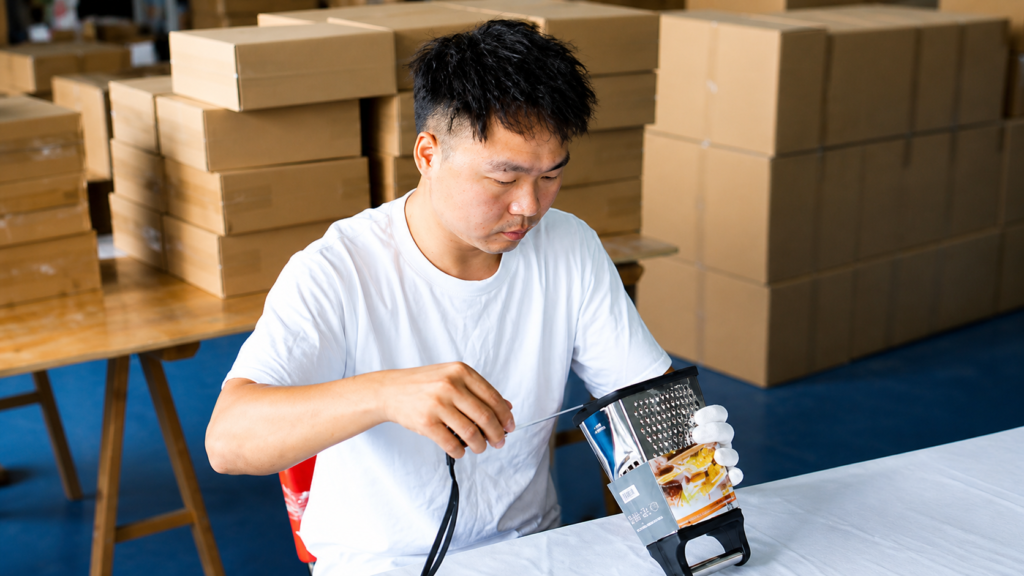
Quality control is one of the most important logistics steps because it prevents defective products from moving through the supply chain. Once defective products are shipped to customers or Amazon, the seller may face returns, bad reviews, disposal fees and replacement costs.
Inspection can include:
- Quantity check
- Visual inspection
- Product function test
- Size and color verification
- Packaging inspection
- Label check
- Carton strength check
- Accessory check
- Random sampling
- Photo report
- Defect classification
The level of inspection should match product risk. A simple accessory may need a basic quantity and visual check. A battery-powered device, product for children or high-value item may need deeper inspection.
Fyllhub provides China inspection support for sellers who want quality issues identified before export. Inspection does not guarantee perfection, but it reduces avoidable surprises.
Warehouse Receiving in China
When goods leave the supplier, they should move into a controlled receiving workflow. The China warehouse should know what is expected before the truck arrives.
A proper receiving process includes:
- Purchase order reference
- Supplier name
- Expected SKU list
- Expected carton count
- Expected unit count
- Carton photos
- Damage check
- Weight and dimension check
- SKU identification
- Discrepancy report
- Storage location assignment
Receiving is where many hidden problems appear. A supplier may ship fewer units than expected, mix variants, use weak cartons or send products without labels. If these problems are caught in China, they can often be corrected before international shipping.
China Warehouse Storage
Storage is not just putting cartons on shelves. Ecommerce inventory needs to be organized so orders can be picked accurately and stock levels can be tracked.
A China warehouse should manage:
- SKU locations
- Batch or lot references when needed
- Carton and unit counts
- Stock movement records
- Damaged stock separation
- Aging inventory visibility
- Reserved inventory for campaigns
- Reorder point alerts
- Packing material inventory
- Photo records where useful
Good storage supports faster fulfillment and better planning. Bad storage creates wrong shipments and stock confusion.
Sellers with larger catalogs can review Fyllhub's China warehouse services guide to understand how storage supports fulfillment and freight.
Pick and Pack Fulfillment
Pick and pack is the daily workflow that turns inventory into shipped orders. The seller's store or marketplace sends order data, the warehouse picks the correct SKU, packs the product, prints labels and hands the parcel to the carrier.
A reliable pick and pack workflow needs:
- Accurate SKU mapping
- Clear order data
- Correct customer address
- Packing rule by SKU
- Branded packaging if needed
- Insert rules
- Carrier and route selection
- Tracking number return
- Exception handling
- Daily dispatch cutoffs
Direct-to-consumer fulfillment from China can work well when products are compact, delivery expectations are realistic and tracking is reliable. It can support Shopify, WooCommerce, crowdfunding, social commerce and multi-country sales.
Fyllhub's China order fulfillment guide goes deeper into when direct shipping from China makes sense.
Freight Forwarding and Bulk Replenishment
Not every order should ship one by one. When demand becomes predictable, bulk replenishment can reduce per-unit shipping cost and improve delivery speed in the destination market.
Freight options may include:
- Express courier
- Economy parcel
- DDP shipping
- Air freight
- Sea freight
- Rail freight for some routes
- Trucking after arrival
- Amazon FBA delivery
- Local 3PL replenishment
The best option depends on urgency, product size, inventory level, destination, margin and customer promise. A small urgent shipment may justify express. A seasonal replenishment order may move by sea if planned early.
For sellers comparing freight options, Fyllhub's China freight forwarder guide and DDP shipping from China guide can help structure the decision.
Amazon and Marketplace Logistics
Many ecommerce brands sell through Amazon and direct websites at the same time. Their China logistics workflow needs to support both.
For Amazon, the workflow may include:
- Supplier receiving
- Product inspection
- FNSKU labeling
- Poly bagging or bubble wrap
- Bundle assembly
- Carton labeling
- Box content data
- Shipment plan support
- Freight to Amazon fulfillment centers
For direct ecommerce, the workflow may include:
- Branded packaging
- Pick and pack
- International parcel shipping
- DDP route selection
- Tracking updates
- Replacement shipments
- Returns planning
The same China warehouse can often support both models if the SKU data and operational rules are clear. Fyllhub can support Amazon FBA prep service and direct ecommerce fulfillment from China.
Inventory Planning
Inventory planning connects logistics to cash flow. Too little inventory creates stockouts. Too much inventory creates storage cost and cash pressure. The right plan depends on lead time, demand, supplier reliability and shipping method.
Track these metrics:
- Average daily sales by SKU
- Reorder point
- Production lead time
- Inspection time
- Warehouse receiving time
- Freight transit time
- Customs and delivery time
- Safety stock
- Seasonal demand
- Advertising campaign schedule
- Marketplace stock limits
Sellers should also classify SKUs:
- Core bestsellers
- New test products
- Seasonal products
- Long-tail variants
- Spare parts
- Slow-moving stock
- Products for marketplaces
- Products for direct websites
Each group may need a different logistics model. Bestsellers may move in bulk to local warehouses. Test products may stay in China. Spare parts may ship on demand. Seasonal products need earlier planning.
Packaging Strategy
Packaging affects cost, damage rate, customer experience and fulfillment speed. Suppliers often choose packaging for factory convenience, not ecommerce delivery.
A strong packaging strategy considers:
- Unit protection
- Carton strength
- Shipping weight
- Dimensional weight
- Barcode placement
- Retail presentation
- Brand experience
- Return risk
- Marketplace requirements
- Carrier handling
- Sustainability goals
Small packaging changes can improve margin. Reducing empty space can lower shipping cost. Stronger inner protection can reduce damage. Clear barcode placement can reduce fulfillment mistakes.
Packaging should be tested before mass production. Sellers should ask the supplier or warehouse for photos and measurements after final packaging, not just sample packaging.
Customs and Compliance Planning
Cross-border ecommerce requires accurate documentation. Sellers should not treat customs data as a last-minute formality.
Prepare:
- Product description
- HS code research
- Declared value guidance
- Country of origin
- Commercial invoice
- Packing list
- Battery or dangerous goods information
- Product certificates if needed
- Importer details where required
- Marketplace or country restrictions
The details vary by country and product. A toy, cosmetic, electronic device or battery product may need different review than a simple accessory. Sellers should confirm requirements with a qualified customs or compliance professional when products are regulated.
Good compliance planning reduces delivery delays, customs holds and unexpected costs.
Technology and Order Data
As order volume grows, spreadsheets become risky. A fulfillment workflow should eventually connect to order systems, inventory data and shipping updates.
Useful data flows include:
- Store orders to warehouse
- Warehouse inventory to seller
- Tracking numbers to store
- Shipment status to customer
- Stock alerts to purchasing
- Returns data to support team
- SKU performance to planning
The technology does not need to be complex at the beginning. It does need to be accurate. Wrong SKU mapping will create wrong shipments even if the warehouse team works carefully.
For Shopify and WooCommerce sellers, Fyllhub can support workflows connected to Shopify fulfillment from China and WooCommerce fulfillment from China.
Common Ecommerce Logistics Mistakes
Choosing a supplier only by price
Low unit price can disappear when packaging is weak, quality is unstable or shipping cost is high. Evaluate total landed cost.
Skipping inspection
Shipping defective products faster does not solve the problem. It only moves the problem closer to the customer.
Ignoring carton dimensions
Dimensional weight can change shipping cost dramatically. Sellers should measure final packaged units and cartons.
Using one route for every SKU
Different products need different routes. Heavy products, lightweight accessories, urgent samples and seasonal stock should not always move the same way.
Not planning inventory by stage
New products, bestsellers and long-tail variants need different storage and replenishment strategies.
Poor SKU naming
Confusing SKU codes create picking mistakes, wrong labels and bad reporting. Every variant should have a stable identifier.
No return or replacement plan
Returns and replacement parts should be part of the logistics design, not invented after customers complain.
90-Day Logistics Setup Plan
New sellers can build a stronger China logistics workflow in phases.
Days 1 to 30: Foundation
Choose suppliers, collect samples, build SKU data, confirm packaging, estimate shipping options and decide which products need inspection.
Days 31 to 60: Warehouse and prep
Receive inventory in China, inspect stock, create labels, define packing rules, prepare carton data, test fulfillment and compare freight routes.
Days 61 to 90: Optimization
Track delivery times, shipping cost, damaged orders, stockouts, returns and customer support issues. Move proven bestsellers to better routes or local storage when the data supports it.
This phased approach gives sellers room to learn before committing too much inventory to one channel or country.
Logistics KPIs to Review Monthly
Once the workflow is running, sellers should review logistics performance every month. The goal is not just to know whether packages shipped. The goal is to understand which part of the system is protecting margin and which part is creating friction.
Track monthly:
- Average delivery time by route
- Shipping cost per order
- Fulfillment error rate
- Damaged order rate
- Return reason by SKU
- Stockout days
- Inventory aging
- Supplier delay frequency
- Inspection defect rate
- Customer support tickets about delivery
- Actual landed cost by SKU
These numbers help sellers make better decisions. A route that looks cheap may create too many complaints. A product that looks profitable may lose margin through returns and replacements. A supplier that quotes well may cause delays that weaken the whole launch calendar. Logistics improves when sellers turn operational data into monthly actions.
How Fyllhub Helps with Ecommerce Logistics from China
Fyllhub helps ecommerce sellers coordinate the China side of their logistics workflow. Instead of managing sourcing, inspection, storage, prep, shipping and fulfillment through disconnected vendors, sellers can build a more integrated process.
Fyllhub can support:
- China sourcing support
- Supplier coordination
- Product inspection
- Warehouse receiving
- SKU storage
- Labeling and barcoding
- Kitting and bundling
- Branded packaging
- Pick and pack fulfillment
- Amazon FBA prep
- Freight forwarding
- DDP shipping options
- Replacement shipments
- Bulk replenishment to local warehouses
If you source products from China and want a cleaner logistics workflow, you can request a custom quote from Fyllhub. Share your product category, supplier locations, SKU count, monthly order volume, target countries, packaging needs and current logistics challenges.
FAQ
What is Ecommerce Logistics China?
Ecommerce Logistics China is the end-to-end workflow for sourcing, inspecting, storing, preparing and shipping products from China to customers, marketplaces or local warehouses.
Why is China important for ecommerce logistics?
Many ecommerce products are manufactured in China. Managing logistics near suppliers can improve inspection, packaging control, supplier consolidation, fulfillment flexibility and replenishment planning.
Should I ship orders directly from China or use a local warehouse?
Direct shipping from China can work for new products, long-tail SKUs and multi-country testing. Local warehouses are often better for proven bestsellers that need faster domestic delivery.
What should be checked before products leave China?
Sellers should check product quality, quantity, packaging, labels, carton data, SKU accuracy, customs information, shipping route and final order or replenishment plan.
Can Fyllhub handle sourcing and fulfillment together?
Fyllhub can support China sourcing, supplier coordination, inspection, warehouse storage, pick and pack fulfillment, Amazon FBA prep and freight forwarding workflows.
How do I reduce ecommerce shipping costs from China?
Compare total landed cost by SKU, improve packaging dimensions, consolidate suppliers, separate bestsellers from long-tail products, use the right freight route and plan replenishment earlier.
What is the first step in building China ecommerce logistics?
Start with clean product data and supplier review. Then define inspection standards, warehouse receiving rules, packaging requirements, shipping routes and inventory planning before products ship.
Final Thoughts
Ecommerce Logistics China is not one task. It is a connected system that starts with sourcing and ends with the customer experience. Every decision affects the next step: supplier choice affects quality, packaging affects shipping cost, inspection affects returns, and inventory planning affects cash flow.
Sellers who build the system early can move faster with fewer surprises. They can test new products in China, move winners to Amazon or local warehouses, keep long-tail SKUs flexible and protect customer experience across channels.
Fyllhub can help build that China-side logistics system for ecommerce brands. To review your sourcing, warehousing, fulfillment or freight workflow, request a quote from Fyllhub.





 Chat on WhatsApp